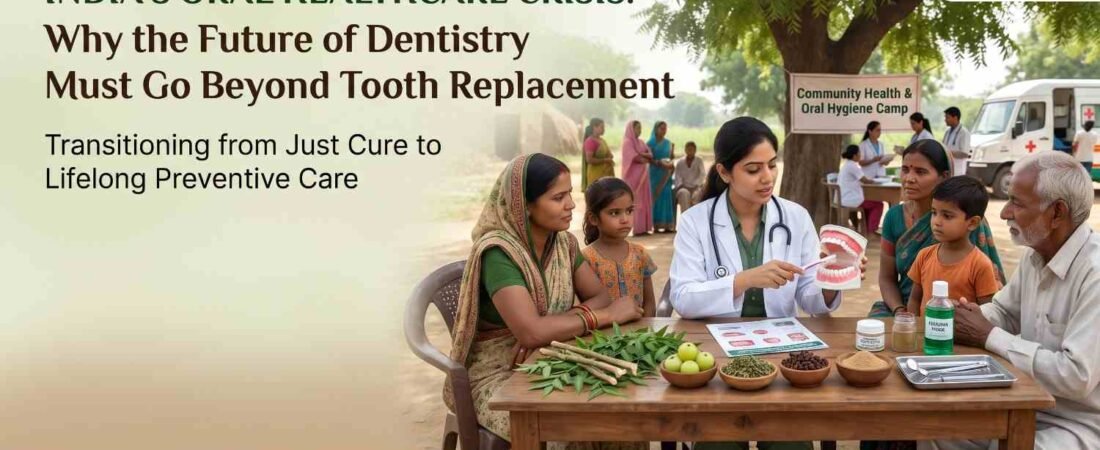
India’s dental healthcare landscape is entering a critical period. Advanced implantology, digital dentistry, and full-mouth rehabilitation offer new possibilities for restoring oral function. Practices such as Advanced Dental Care illustrate the expanding availability of restorative technology. Yet a fundamental challenge remains: millions of Indians continue to experience preventable dental diseases before they reach the stage of requiring complex treatment.
The World Health Organization’s India Oral Health Country Profile, published in 2022, estimated that 28.8% of people aged five and above had untreated dental caries in permanent teeth in 2019. Severe periodontal disease affected 21.8% of individuals aged 15 and above.
These figures suggest that India’s dental healthcare challenge cannot be addressed through treatment expansion alone. The larger opportunity lies in identifying disease earlier, preserving natural teeth and reducing avoidable tooth loss.
The economic consequences are substantial. WHO estimated that five major oral diseases collectively contributed to approximately US$7.25 billion in productivity losses in India in 2019. Oral health is therefore more than an individual clinical concern; it has implications for workforce productivity, healthcare financing and quality of life.
Comprehensive dental services offered by practices such as a Dental Clinic demonstrate how preventive, restorative, and prosthetic treatments can be available within a coordinated care setting. The wider challenge is ensuring that patients receive appropriate treatment before manageable conditions progress into irreversible damage.
1. India’s Oral Disease Burden Is Larger Than Tooth Decay
Tooth decay remains a substantial public health concern, but it represents only one component of India’s oral disease burden.
According to WHO estimates for 2019, 43.3% of children aged one to nine had untreated decay in primary teeth. Among adults aged 20 and above, 4% experienced complete tooth loss, clinically known as edentulism.
These findings highlight the importance of oral healthcare throughout life.
Untreated decay can progress to infection and eventual tooth loss, while advanced periodontal disease damages the supporting structures of teeth.
A 2023 peer-reviewed analysis of the WHO Global Oral Health Status Report estimated approximately 367 million cases of caries affecting permanent teeth and 221 million cases of severe periodontal disease in India in 2019.
These are modelled disease estimates, not counts of patients receiving dental treatment.
The findings nevertheless establish an important priority: preventing disease progression should receive as much attention as developing advanced restorative services.
2. Tooth Replacement Must Begin With Tooth Preservation
Dental implants have transformed restorative dentistry by providing an option for replacing missing teeth without relying on adjacent natural teeth for support.
However, implants should not automatically be considered the preferred solution for every damaged tooth.
Where clinically feasible, periodontal treatment, endodontic therapy, and appropriate restorations may allow natural teeth to be preserved.
Treatment selection depends on bone support, the extent of decay, periodontal condition, overall health and long-term prognosis.
For patients requiring replacement, implants, bridges and removable prostheses each involve different clinical considerations.
The WHO estimated complete tooth loss among 4% of Indians aged 20 and above in 2019. This demonstrates a measurable need for oral rehabilitation, although it does not establish how many individuals are suitable candidates for dental implants.
A responsible approach prioritises diagnosis, treatment alternatives, informed consent and maintenance requirements rather than promoting a single procedure.
3. Digital Dentistry Is Changing Treatment Planning
Digital technologies are influencing the way dentists evaluate and restore teeth.
Intraoral scanners, cone-beam computed tomography, computer-assisted implant planning and digitally manufactured restorations can improve anatomical visualisation and support prosthetic design.
For implant treatment, three-dimensional imaging may help assess available bone and the position of important anatomical structures when clinically indicated.
Digital workflows can also facilitate communication between dental surgeons, prosthodontists and dental laboratories.
However, advanced equipment does not independently guarantee better outcomes.
Long-term restoration success depends on appropriate case selection, treatment execution, oral hygiene and follow-up.
Digital dentistry should therefore be understood as a clinical planning resource rather than a substitute for professional judgement.
4. Affordability Remains a Significant Treatment Barrier
India’s oral healthcare challenge is closely connected with financial access.
The WHO’s 2022 country profile reported approximately 271,744 dentists in India in 2019, equivalent to about two dentists per 10,000 people.
National workforce figures alone cannot establish whether dental services are geographically accessible or affordable.
A particularly important development emerged in March 2026, when India’s Ministry of Health and Family Welfare clarified in Parliament that routine dental treatments, including fillings and root canal therapy, are generally excluded from standard health insurance policies.
The government also stated that outpatient dental treatments are not covered under Ayushman Bharat PM-JAY because the scheme primarily covers eligible hospitalisation services.
This creates an important policy concern.
When preventive and restorative dental treatment requires direct household payment, patients may delay care until symptoms become severe.
Expanding affordable early intervention could reduce the need for more complex treatment later.
5. Oral Cancer Prevention Must Remain a National Priority
Dental policy must also address India’s substantial oral cancer burden.
WHO’s India country profile estimated approximately 135,929 new cases of lip and oral cavity cancer in 2020.
The same report estimated current tobacco use among 28.1% of people aged 15 and above in 2019.
Although these figures come from different datasets, they reinforce the importance of tobacco cessation support, risk assessment and timely evaluation of suspicious oral lesions.
Dental professionals have an important role in identifying persistent ulcers, abnormal tissue changes and other symptoms requiring investigation.
A comprehensive dental consultation should extend beyond individual teeth to include appropriate examination of the oral cavity and surrounding tissues.
6. India’s Next Dental Healthcare Priority Is Prevention
India’s National Oral Health Programme provides a framework for strengthening oral health awareness and services.
However, future progress should be assessed through meaningful outcomes, including reduced untreated decay, earlier periodontal diagnosis, preservation of natural teeth and improved access to rehabilitation where necessary.
Public education, school-based prevention, affordable preventive services and regular dental assessments can help address disease before irreversible damage occurs.
Advanced implantology and prosthodontics will remain important, particularly for patients experiencing tooth loss and functional difficulties.
Yet technological sophistication should complement, not overshadow, basic oral healthcare.
Conclusion
India’s oral healthcare system faces two simultaneous responsibilities: managing widespread preventable disease and expanding access to appropriate restorative treatment.
The evidence suggests that improving dental health requires more than increasing the availability of implants, digital equipment or cosmetic procedures.
The next meaningful achievement in Indian dentistry will be measured not only by how effectively missing teeth can be replaced, but by how many natural teeth can be preserved through timely, accessible and evidence-based care.