

While progress is being made in the area of the health care of children in India, particularly with respect to neonatal care, immunization and pediatric specialists, vision health of children remains an area where early detection can make a huge difference. The 24×7 Pediatric Hospital at Parel is part of the broader pediatric care structure in the city. Children can be identified with developmental problems, including vision problems, during their routine childhood health checks as part of their general pediatric care.
The pooled prevalence of refractive errors in children in India was estimated to be 11% in a recent online systematic review of 43 studies conducted in India. The prevalence of myopia was found to be about 8%, astigmatism about 3%, and hyperopia about 1%.
Children suffering from blurred vision, headaches, or inability to read are unaware that their eyesight needs correction. Suffering from refractive error, children can be mistakenly diagnosed with poor concentration or learning problems by their parents or teachers.
Screening children for vision problems goes beyond treating eye problems. It ensures that children with vision problems are identified early and can be treated in time so that they can reach their full potential in development and education.
A 24×7 Pediatric Hospital in Parel would support the Early Vision Screening model by allowing specialist eye services provided by an Eye Hospital in Mumbai to carry out comprehensive eye examinations, including a refractive error assessment and treatment for all childhood eye diseases. This would enable reliable referral pathways for families, schools, pediatricians, and ophthalmologists.
1. India’s Childhood Refractive Error Burden Requires Attention
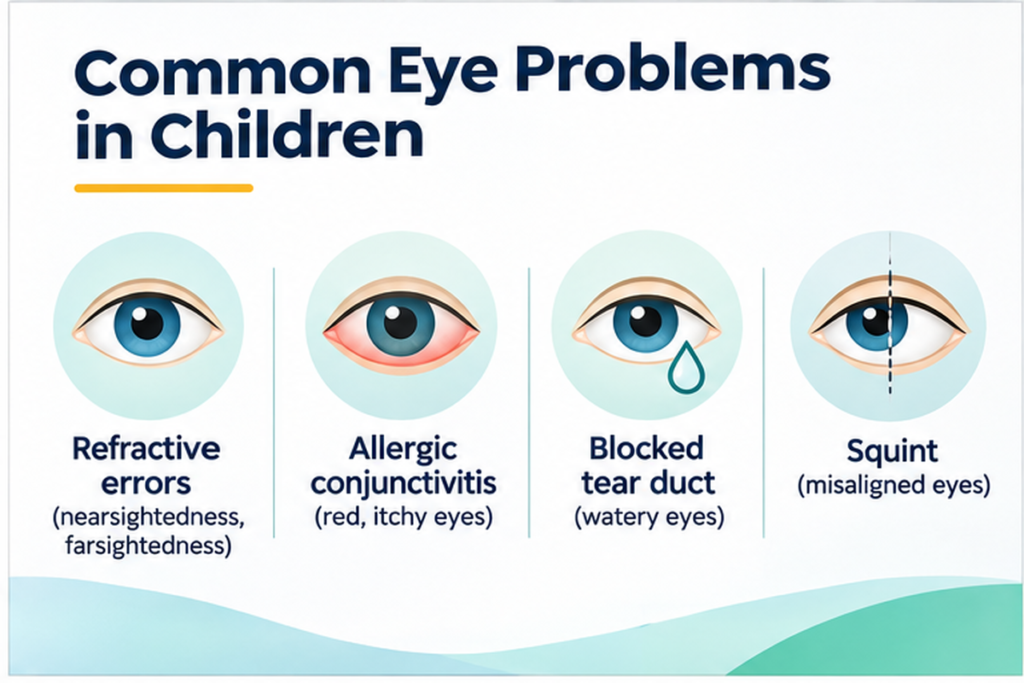
Refractive errors are the most common cause of correctable visual impairment in children.
A systematic review of 43 studies across India found an overall pooled prevalence of refractive error of 11% among school-going children.
Another meta-analysis carried out in India, which analyzed the results of 59 studies published between 1980 and 2020, estimated the prevalence of myopia in children aged 5–15 years to be 7.5%. There was a marked urban-rural difference, with children from urban areas having a myopia prevalence of 8.5% as against 6.1% in children from rural areas.
These studies, however, showed a marked difference between urban and rural children. Myopia was estimated to occur in approximately 8.5% of urban children and 6.1% of rural children.
In the above studies, it is difficult to establish a single nationwide prevalence for refractive errors for the year 2026, as there are many studies done in different age groups and in different locations using different methods of assessment.
While it is not possible to establish a single nationwide prevalence for 2026, based on the above-mentioned studies, it appears that there are vision problems in a significant proportion of school-going children.
Screening will identify children who require a full assessment and help prevent vision problems that could interfere with a child’s activity later in life.
2. School Screening Offers a Scalable Public Health Opportunity
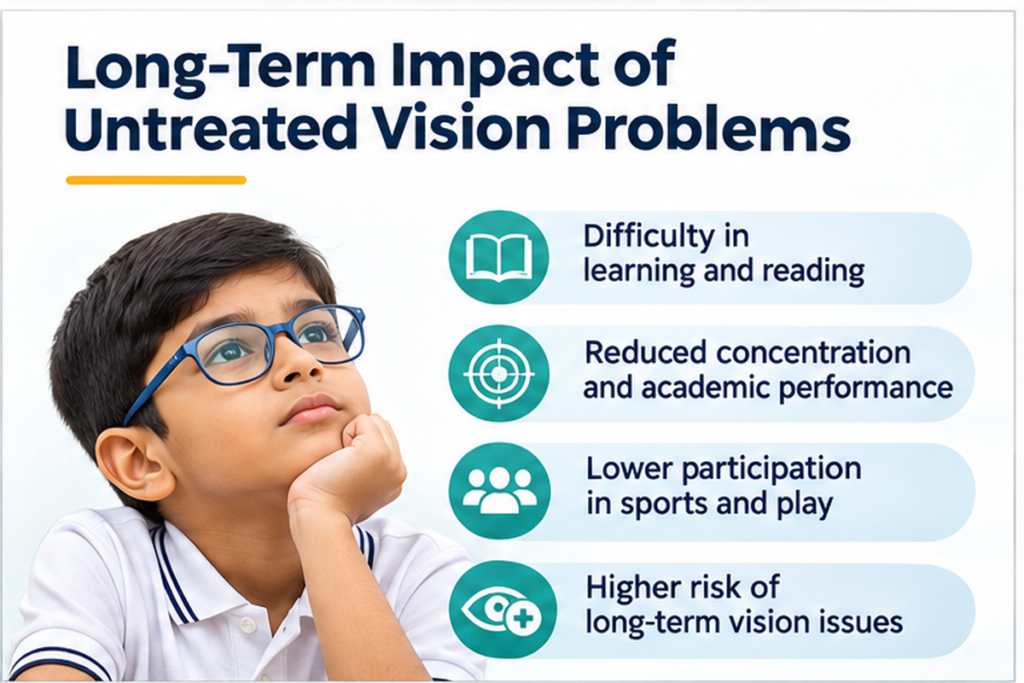
India has already implemented a large-scale school eye screening program successfully.
The Refractive Errors Among Children (REACH) program was implemented in 10,309 schools across 5 states of India and included 2,24,706 children between the ages of 5 years and 18 years.
Of these, approximately 2.02 million underwent initial vision screening.
Of these, approximately 174,706 children (8.6% of children screened) required detailed assessment to confirm vision problems.
Schools are an effective mode to implement large-scale screening for refractive errors in children in rural and government schools.
However, screening alone does not ensure improved eyesight.
Children identified with possible vision problems need a confirmatory examination, glasses when necessary, and continued follow-up.
The most important measure for a school vision screening program is the percentage of children who have vision problems identified through screening and are using their glasses.
3. Childhood Eye Health Should Begin Before School
Vision concerns are not limited to schoolchildren.
Infants and preschool-age children can have a number of eye problems, including congenital eye abnormalities, squint, and amblyopia, which can be treated if caught early.
Premature infants represent an especially important high-risk group.
India’s National Health Mission has listed retinopathy of prematurity (ROP) as a potential cause of permanent vision loss in premature children and states that its incidence in ‘high risk’ preterm children has been reported to be as high as 24% to 47% in various studies conducted in the country.
The guidelines for ROP screening, according to National Health Mission guidelines, state that the ROP incidence in high-risk premature infants in Indian studies has been reported to range from 24% to 47%.
ROP is not prevalent among all newborns; the rate in high-risk premature children has been reported to be as high as 24% to 47% in Indian studies.
ROP is a rapidly progressing disease and can cause permanent blindness if not treated in time. Therefore, timely screening of eligible premature infants for signs of ROP is required.
So, it is very important to have timely neonatal and ophthalmological care for these high-risk premature babies.
So the message is that childhood eye health needs to be assessed at the appropriate age, not left until the child is of school age and then first assessed in school.
4. Paediatricians Can Help Identify Vision Problems Earlier
The paediatrician’s work in the field of paediatric care is ongoing and provides the clinician with multiple occasions to assess the child’s development.
During health assessments of children of different ages, clinicians may find deviations of refractive error, strabismus, decreased vision, poor eye movements, frequent squinting, or decreased distant visual acuity and inability to read and see objects far away.
Some children with vision problems may complain of headaches or want to be as close as possible to TV screens and may even rub their eyes from time to time.
These signs or symptoms alone can be suspicious for an eye problem, but more investigation is needed to confirm whether there is a problem or not.
For refractive errors or eye diseases that are suspected, referral to an appropriate eye-care provider is needed.
This would include visual acuity testing of children of all ages and even refraction using cycloplegic agents as needed for accurate assessment of refractive error. An eye examination would also be indicated in such children.
The partnership between Paediatricians and Eye-care specialists means children’s eye problems can be picked up by the Paediatrician and then dealt with by an Ophthalmologist and his team to get a definitive diagnosis and treatment.
5. India’s Public Programmes Show Progress, but Follow-Up Matters
National Programme for Control of Blindness and Visual Impairment supports school eye screening and spectacles.
According to the Ministry of Health and Family Welfare’s 2023–2024 Annual Report, 11.01 lakhs of free spectacles were distributed to school children having refractive errors.
This represents an important public healthcare intervention.
Just getting children’s eyes fixed with free spectacles does not mean that they will actually wear them all the time.
An AIIMS-associated Indian school-screening study of 6,056 primary school pupils found that even after issuing spectacles, the spectacle-use compliance at six-month follow-up was only 36%.
The findings of the study may not be generalised to all children of Indian origin.
The findings of the study, however, can help plan follow-up, education of families and eye care in schools.
6. The Next Priority Is Integrated Childhood Vision Care
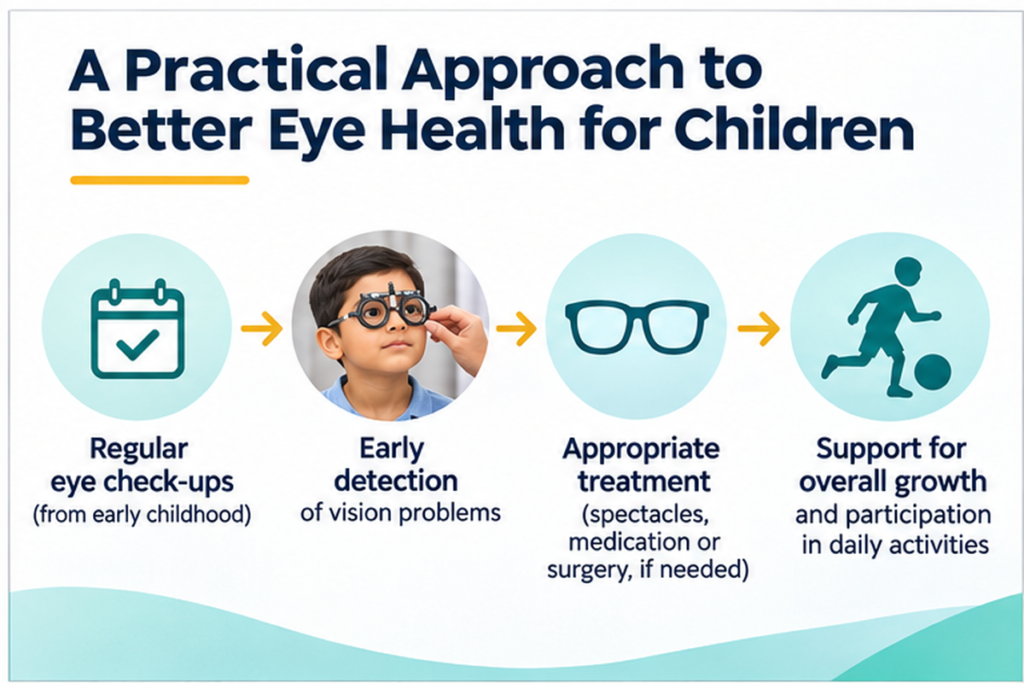
The future strategy for childhood eye health in India would be to integrate 3 major systems: Paediatric health care, School screening programs, and Specialist ophthalmology services, including optometry.
Paediatricians can identify developmental and clinical warning signs.
Schools can be instrumental in implementing a systematic screening for visual defects and can also recognize the many visual defects caused by school work and the classroom environment.
Ophthalmologists and Optometrists will undertake a detailed assessment of the child’s eyes, provide appropriate treatment and prescribe the correct vision correction if required.
Digital records and structured referral pathways can help manage children on long-term follow-up for eye diseases.
The integration of childhood eye health programs into all levels of health care can help to minimize ‘lost referrals’ and ensure that screen-positive children can receive appropriate and necessary care.
These treatments should not be individualized only by the degree of visual impairment that a child has suffered. Many eye problems are best treated with no eye treatment at all, while others require treatment other than simple glasses for refractive errors.
Conclusion
India’s childhood vision challenges require attention from across the entire healthcare system.
Evidence of high prevalence of refractive errors and of the success of large-scale screening programs for millions of children exists.
Connecting the identification of vision problems with specialist assessment, treatment, and monitoring of children with vision problems is the biggest challenge that needs to be addressed.
A meaningful measurement for India’s next childhood eye-health milestone would be the number of children who receive timely eye care to protect their eyes, help their development, and learn to read well in school.