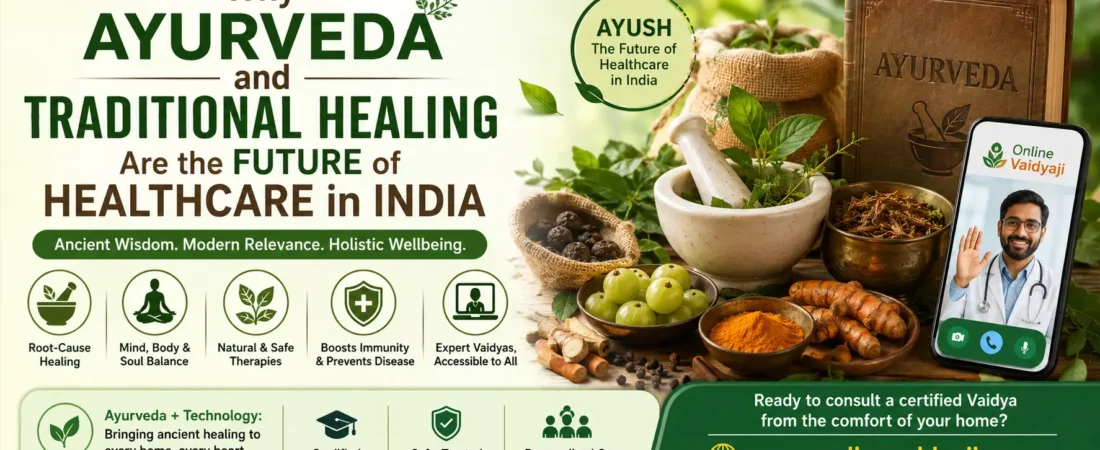
India is witnessing a quiet revolution in healthcare. While modern medicine continues to play a critical role in treating acute conditions, millions of Indians are rediscovering the deep wisdom of their ancestral healing traditions — Ayurveda, Yoga, Unani, Siddha, and Homeopathy. And this time, they are not choosing tradition instead of modernity — they are choosing it alongside it.
What Is Ayurveda and Why Does It Matter Today?
Ayurveda, literally meaning “the science of life” (Ayur = life, Veda = knowledge), is one of the world’s oldest holistic healing systems. Originating in India over 5,000 years ago, Ayurveda is built on the understanding that health is not merely the absence of disease — it is a state of complete physical, mental, and spiritual balance.
At its core, Ayurveda recognizes that every individual has a unique Prakriti (body constitution) determined by three doshas — Vata, Pitta, and Kapha. Imbalances in these doshas are seen as the root cause of illness, and Ayurvedic treatment focuses on restoring this balance through personalised diet, lifestyle, herbal remedies, and therapies like Panchakarma.
This personalized, root-cause approach is precisely why Ayurveda is gaining relevance in today’s world — where lifestyle diseases like diabetes, obesity, hypertension, and anxiety are at epidemic levels, and where conventional medicine often manages symptoms rather than addressing underlying causes.
The Growing Shift Towards Traditional Healing
The COVID-19 pandemic was a turning point. As millions of Indians sought ways to boost immunity and manage stress naturally, interest in Ayurvedic herbs like Ashwagandha, Tulsi, Giloy, and Turmeric surged globally. The Indian government’s push for AYUSH as a mainstream healthcare option added further credibility.
According to industry estimates, the Indian AYUSH market is projected to reach over Rs. 1.5 lakh crore by 2025, reflecting a massive resurgence of consumer confidence in traditional systems.
Why Traditional Healing Works — The Science Behind It
Critics of Ayurveda often point to a lack of large-scale clinical studies. However, the global scientific community is increasingly validating many Ayurvedic principles:
- Turmeric (Curcuma longa) and its active compound curcumin have been studied for anti-inflammatory and anti-cancer properties in hundreds of peer-reviewed papers.
- Ashwagandha (Withania somnifera) has demonstrated significant effects on cortisol reduction and stress management in clinical trials.
- Triphala, a classic Ayurvedic formulation, has shown powerful antioxidant and digestive benefits in modern research.
What makes Ayurveda uniquely powerful is not just its herbs — it is the system behind them: the understanding that food is medicine, that lifestyle determines health, and that prevention is always better than cure.
The Role of Certified Vaidyas in Traditional Healing
One of the biggest misconceptions about Ayurveda is that anyone can practice it. In reality, a qualified Ayurvedic practitioner — called a Vaidya — undergoes a rigorous 5.5-year BAMS (Bachelor of Ayurvedic Medicine and Surgery) degree, followed by clinical training.
This is why platforms like Online Vaidyaji are transforming access to traditional healthcare — by connecting patients with verified, degree-holding AYUSH practitioners online and offline, ensuring that the wisdom of Ayurveda is delivered safely and effectively.
Ayurveda + Technology: The Perfect Partnership
The future of traditional healing lies in making it accessible. Digital platforms are now enabling patients from tier-2 and tier-3 cities to consult certified practitioners via video call, receive digital prescriptions, and follow personalised wellness plans from home.
This convergence of ancient wisdom and modern technology is not a contradiction. It is an evolution — one that honors the depth of India’s healing traditions while making them available to every Indian, regardless of location or schedule.
Conclusion
Ayurveda and traditional healing are not relics of the past. They are a sophisticated, time-tested science that is finally getting the platform — and the technology — it deserves. As India moves towards a more holistic understanding of health, the wisdom of our ancestors is not just relevant. It is essential.
Ready to consult a certified Vaidya from the comfort of your home?